Posts

Results, Holdings, and Plurality Opinions

Image
When the Supreme Court issues an opinion (in Supreme Court speak when an opinion is "handed down") it's important to distinguish which side won (a very simple task) from what the case holds (a task that can challenge even the best lawyers and judges).  This distinction--results versus holdings--is always important and may become crucial this term with many important, highly complex, and hotly disputed cases.  I hope this long post helps you sort through what could be some very confusing cases.   Let's start with simple arithmetic and a simple case.  Let's say the case is from the Third Circuit and one for which the Supreme Court granted cert: call it P v. R.   P is the petitioner, who got his cert petition granted and wants the Supreme Court to reverse the Third Circuit.  R is the respondent who didn't want cert granted and wants the Third Circuit to be affirmed.    The Court has nine members...
Circuit Assignments/A Death Penalty Case

Image
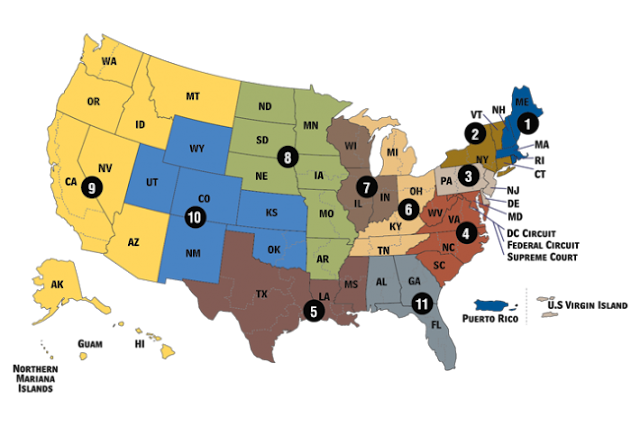
                                        Map of the Federal Appellate Courts Did you know that the 13 federal circuit courts (11 numbered circuits plus the District of Columbia and the Federal Circuit) each get their own Justice?  They do.  And they have for a long time.  Effective June 27, 2017 (basically at the end of the October 2017 term) the current circuit assignments were issued.  Other than being required by statute ( 28 U.S.C. §42 ), why is this done? As our friends at SCOTUSblog  succinctly put it: "Circuit Justices are responsible for ruling on certain motions arising from their assigned circuits, such as motions for extensions of time.  In the case motions for a stay of execution or other motions relating to death penalty matters, the Circuit Justice ordinarily refers the motion to the Court as a whole, ...

Update on DACA/How To Tell Who Is Who In An Appeal

As promised, here is an update on the DACA case. (To see the full docket in the Supreme Court, click here .  To see my recent post on the case and DOJ's attempt to obtain certiorari before judgment, click here ). Today (January 23) the Supreme Court issued the following order: ORDER IN PENDING CASE 17-1003 DEPT. OF HOMELAND SEC., ET AL. V. REGENTS OF UNIV. OF CA, ET AL. The motion of petitioners to expedite consideration of the petition for a writ of certiorari before judgment is granted in part. As respondents have agreed, they will file their briefs in  opposition by February 2, 2018.  The "granted in part" refers to the February 2, 2018, date for the respondents (the Regents of the University of California and the named parties with them) to file their brief(s) in opposition to DOJ's petition.  DOJ originally wanted the Court to order respondents to file on January 22.  Obviously, they didn't get the time fr...

Three Opinions And A Grant, Or Peaches,Tasty, And A Frog

Image
As predicted. the Supreme Court handed down opinions today, three of them, one featuring a party thrown by "Peaches" (or maybe "Tasty").  There was also a grant of certiorari that involves a frog. And you thought the law was boring. First, the opinions  [link to Supreme Court website]: National Assn. of Mfrs. v. Department of Defense (16-299): the Court held, by a 9-0 vote, that challenges to the Waters of the United States rule must be filed in federal district court, not federal courts of appeal as is allowed for some challenges under the Clean Water Act.  Takeaway: the opinion by Justice Sotomayor solves this jurisdictional issue by statutory interpretation against the very complex background of how "waters of the United States" is defined and administered.  Major case if you do Clean Water Act work, as I did. Artis v. District of Columbia (16-460): another procedural case, a 5-4 decision, with a majority opinion by Justice Ginsburg, reading ...

One Lonely Opinion (But Stay Tuned For Monday)

Image
It's late January, and not since the 1860's has the Supreme Court taken so long to issue opinions: only one opinion in an orally argued case.  And even if you take into account non-argued  per curiam opinions (unsigned opinions "by the court"), there have only been a total of five .  And to top it all off, the one opinion that was in an orally argued case, Hamer v. Neighborhood Housing Services of Chicago , was a twelve-page unanimous opinion on the difference between "jurisdictional" deadlines and "claim processing" rules, a discussion only appellate law nerds (ahem) could love.  Why is this? Well, as the least leaked branch of government, we really don't know, but here is one idea.  While the Court has a lighter than average docket by the number of cases, they have more than made up for it with the nature of the cases before them.  Consider these cases, the first two (at least) are in the "landmark case" category, and all o...

Can DOJ Skip The Ninth Circuit? Well, They Can Try

Image
You might have heard that the Trump Justice Department is seeking direct review of the district court's decision to enjoin the shutdown of the DACA program and ordering the government to continue to receive renewal applications.  You can read about it here  (a sh ort Politico story) but this post is not about DACA.  It's about what the Justice Department is attempting to do: bypass the Ninth Circuit and have the Supreme Court take the appeal directly.  Can they do that? Yes, they can, but it is (in my opinion) a long shot.  This post will walk you through the rule and the statute.  You'll not only learn to read a citation to a federal law but see how to pick out the operative terms and form your own opinion.  DOJ will be relying on Rule 11 of the Supreme Court of the United States which provides:  Rule 11. Certiorari to a United States Court of Appeals before Judgment A petition for a writ of certiorari to rev...

On A Lighter Note: Rule Haiku

Image
A lot of my recent posts have been about some pretty heavy duty stuff.  That's to be expected, of course: the docket of the Supreme Court is not known as a source of humor.  But not all things law related have to be deadly serious. I've got an example for you which is both a source of humor, or at least light-heartedness, and even instructional.  Legal education can be fun, too. It is a feed I recently found on Twitter: Rule Haiku.  As the site says, "The Federal rules. Turned into haiku. For no real reason."  What Rule Haiku does is just that: take the Federal Rules (Evidence, Civil Procedure, Criminal Procedure, Appellate Procedure) and convert them into a standard haiku format, three lines of  5-7-5 syllables in each line.  It's very inventive, is in keeping with the traditional haiku format, and is a fairly good summary of the rule in 17 syllables.  Here's an example, from the Federal Rules of Evidence: FRE 702. Qualified expert...